Tag: Residential Construction

  • How to Choose a Home Builder in Texas

    How to Choose a Home Builder in Texas

    Choosing the right builder is one of the most important decisions you’ll make when planning a new home. If you’re researching how to choose a home builder in Texas, don’t base your decision on the advertised price or a few impressive project photos. You need to understand how each builder works, which responsibilities they take on, how they manage costs, and whether their approach matches your expectations.

    A home building project involves many connected decisions, from design and materials to scheduling, approvals, and construction. Your builder will coordinate many of these activities, so their approach can influence the entire project. Take time to compare your options before signing an agreement to reduce the risk of misunderstandings later.

    How to Choose a Home Builder in Texas: Start With Your Project Needs

    Before comparing builders, get clear about the home you want to build. A builder who suits a straightforward residential project may not be the right fit for a customized home with specific design, structural, or site requirements.

    Start by outlining:

    • Type of home: Are you planning a custom home, a more conventional new build, a duplex, or another residential project?
    • Size and layout: Have you decided on the approximate size, number of rooms, and main features?
    • Design expectations: Do you already have architectural plans, or will you need design support?
    • Property status: Do you own the land, or are you still evaluating potential sites?
    • Budget: What is your expected construction budget, and which features matter most?
    • Project responsibilities: Do you want one team to coordinate several stages, or will you arrange separate professionals?

    These details give you a clearer basis for comparing proposals. They also help builders understand what you expect them to deliver.

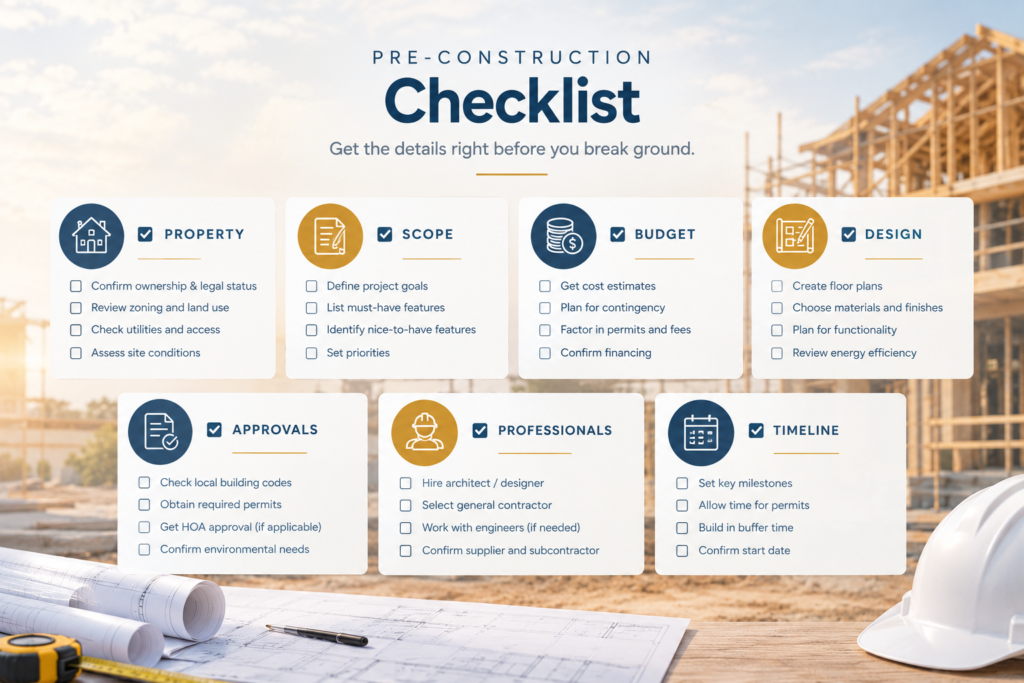
    If you are still working through the early planning stages, the broader How to Start a Construction Project: Step-by-Step Guide explains how project scope, budgeting, design, approvals, and professional selection fit together.

    1. Look for Relevant Home-Building Experience

    A builder’s experience should match the home you want to build. A long list of completed projects means little if those projects differ significantly from yours.

    For example, if you’re planning a custom home with a particular layout, architectural style, or set of structural requirements, ask whether the builder has handled comparable work.

    When reviewing experience, consider:

    • The types of residential projects the builder has worked on.
    • Whether they have experience with homes of a similar size and complexity.
    • Whether their work includes the level of customization you expect.
    • How they approach design coordination and construction planning.
    • Whether they can explain the challenges involved in projects similar to yours.

    Ask to see relevant examples and request details about the builder’s role in each project. Find out whether they managed the full construction process or handled only certain stages.

    You can also read What Does a Custom Home Builder Actually Do? to understand the responsibilities a custom home builder may take on during planning, design coordination, budgeting, and construction.

    The goal is not to find a builder who claims to do everything. It is to find one whose actual experience and responsibilities match your project’s requirements.

    2. Understand What the Builder Will Handle

    Two builders may offer similar-looking proposals while taking on very different responsibilities. One may handle design coordination, budgeting, scheduling, and construction management. Another may provide only a narrower construction service.

    Before making a decision, ask the builder to explain exactly what the proposal includes.

    Depending on the agreement and project structure, responsibilities may involve:

    • Reviewing the project scope and initial requirements.
    • Coordinating design and engineering inputs.
    • Preparing or reviewing construction estimates.
    • Planning the work and construction schedule.
    • Coordinating subcontractors, suppliers, and site activities.
    • Monitoring work against the agreed scope.
    • Communicating progress and decisions.
    • Managing approved changes during construction.

    Do not assume that every builder provides all these services. Ask who will handle each responsibility and whether the proposal includes it or prices it separately.

    This is especially important when several professionals are involved. You should know who will coordinate their work and whom you should contact when a decision or issue needs attention.

    For a more detailed look at the steps involved in a custom build, see How to Build a Custom Home: A Step-by-Step Guide.

    3. Review the Builder’s Process and Communication

    A builder’s process tells you a lot about what working with them may look like. Before hiring anyone, understand how they move from an initial discussion to construction and how they keep homeowners informed along the way.

    Ask the builder to walk you through the main stages of your project.

    You should understand:

    • What information they need before preparing a proposal.
    • How they will review the design and project scope.
    • When they will discuss the budget and major material selections.
    • How they will develop the construction schedule.
    • Who will serve as your main point of contact.
    • How often they will provide progress updates.
    • How they will communicate questions, delays, and unexpected issues.

    Pay attention to how the builder responds during your early conversations. Do they listen carefully to your requirements? Do they explain unfamiliar terms? Are they clear about what they can confirm and what still needs investigation?

    A useful conversation should leave you with a better understanding of the project, not more uncertainty.

    Ask How the Builder Will Handle Changes

    Changes can arise when a homeowner adjusts the design, selects different materials, or requests additional work. Before signing, understand how the builder records and manages these changes.

    Ask whether the builder will explain each change in writing, including its effect on cost or schedule, before proceeding with the work.

    A clear process helps both sides understand what they have approved and what the revised agreement includes.

    4. Compare Estimates, Budgets, and What’s Included
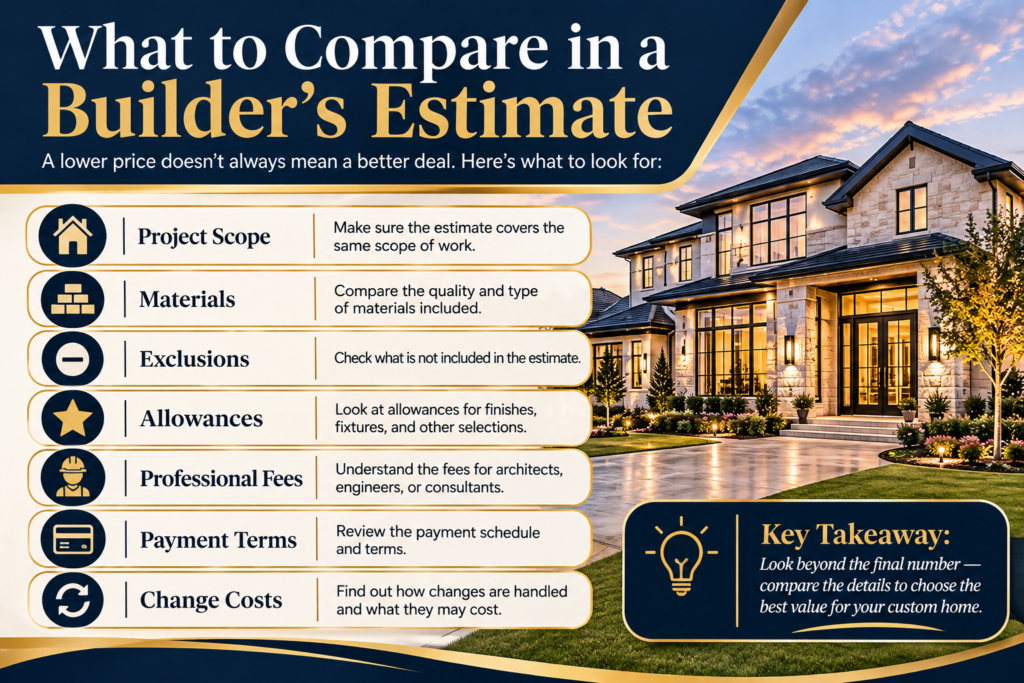
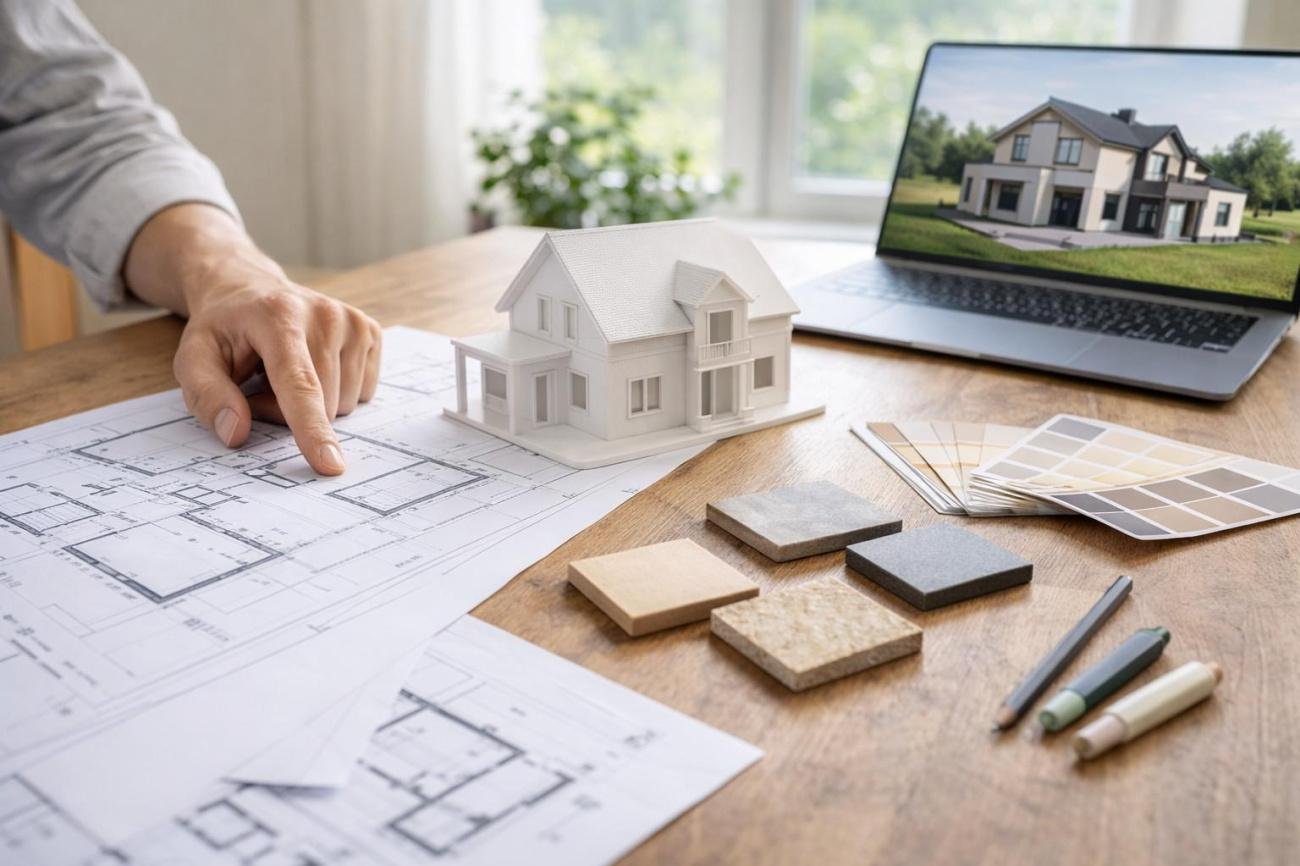
    Items homeowners should compare when reviewing home builder construction estimates.

    The lowest estimate is not automatically the best choice. Two builders may quote different prices because their proposals cover different materials, services, allowances, or project responsibilities.

    When you compare proposals, look beyond the final number.

    A useful estimate should help you understand:

    • The work included in the proposed scope.
    • Materials, finishes, and specifications covered by the price.
    • Items the builder excludes or prices separately.
    • Allowances for selections you have not finalized.
    • Design, engineering, and other professional fees, where applicable.
    • Site preparation and other property-specific work, where applicable.
    • The expected payment structure.
    • How the builder will price additional work and changes.

    If one proposal is significantly lower than another, ask the builder to explain the difference. The builder may have excluded work that another proposal covers, or they may have used different material specifications.

    Avoid comparing proposals until you understand whether they cover the same scope.

    Check How the Builder Will Manage the Budget

    Your initial estimate is only useful if you understand how the builder will manage costs as the project develops.

    Ask:

    1. Who will track project costs?
    2. How will the builder tell you when an expense changes?
    3. Who approves material upgrades or substitutions?
    4. What happens if site conditions require additional work?
    5. How will changes to the original scope affect the budget?

    If you want to understand the wider cost factors involved in a custom home, read Custom Home Construction Cost: What Should You Budget For?

    That resource is particularly useful when you are deciding whether a builder’s estimate reflects the full project or only part of the work.

    5. Read the Contract Before You Commit
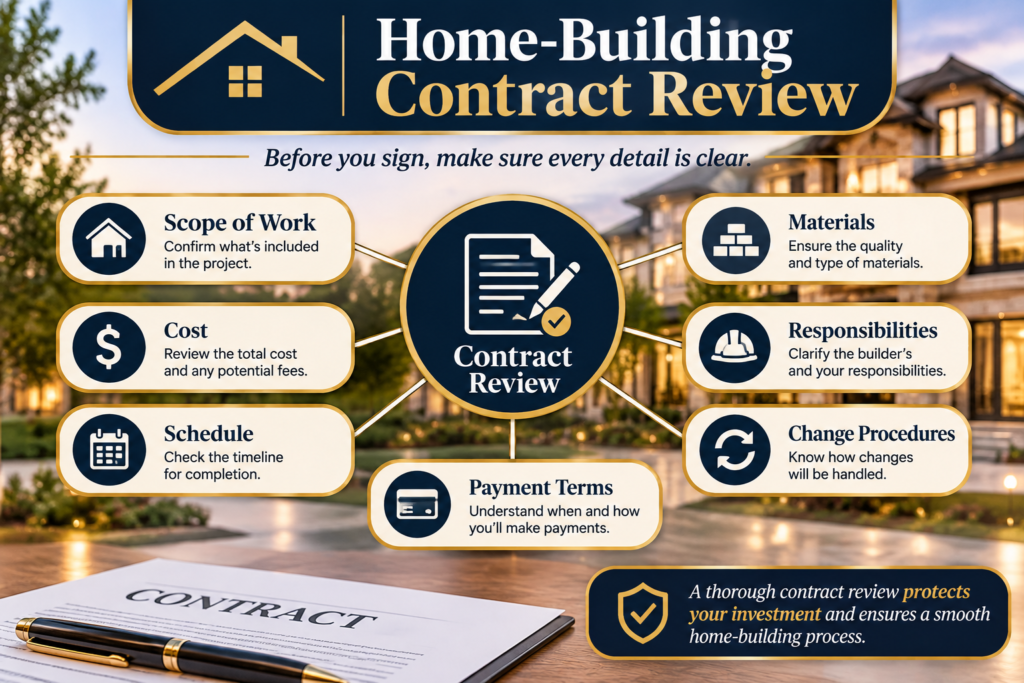
    Important details to review in a Texas residential construction contract.

    A verbal discussion or attractive proposal is not a substitute for a clear written agreement. Before hiring a builder, read the contract carefully and make sure it reflects what you have discussed.

    For a residential construction project in Texas, this is an important step. Section 53.255 of the Texas Property Code requires an original contractor to provide the owner with a residential construction contract disclosure statement before the contract is executed. The statutory disclosure advises homeowners to investigate the contractor and get the agreement in writing.

    You can review the provision in the Texas Property Code, Section 53.255.

    Understand the Texas Contract Disclosure

    Take time to review the disclosure statement and understand the information it provides. It gives homeowners guidance on investigating a contractor and documenting the agreement before construction begins.

    Do not treat the disclosure as a replacement for reviewing the actual contract. You should still check the project’s scope, costs, responsibilities, and other agreed terms.

    Check What Your Home-Building Contract Includes

    As you review the agreement, check whether it clearly explains:

    • Scope of work: What exactly will the builder complete?
    • Project cost: What is the agreed price, or how will the builder determine the final cost?
    • Schedule: What are the estimated or required start and completion dates?
    • Payment terms: When must you make payments, and what conditions apply to each payment?
    • Materials and specifications: Which materials, finishes, and products does the price include?
    • Changes: How will both sides document and price changes to the original scope?
    • Responsibilities: What will the builder handle, and what remains your responsibility?
    • Final completion: What must the builder complete before you consider the project finished?

    Make sure the builder includes every important promise from your meetings or calls in the written agreement.

    Clarify Uncertain Terms Before Signing

    If something is unclear, ask the builder to explain it before you sign. Do not rely on verbal assurances when the written agreement says something different.

    For additional consumer guidance on written bids, references, and contractor agreements, the Texas Attorney General’s guide to avoiding home improvement scams is also worth reviewing. Although it focuses on home improvement work, its advice about checking references, comparing written bids, and reviewing contracts is useful when assessing a contractor.

    If the contract includes unfamiliar legal terms or creates obligations you do not understand, consider having a qualified attorney review it before you commit.

    6. Check References and Look for Warning Signs

    A builder’s portfolio shows examples of their work, but conversations with previous clients can tell you more about the working relationship.

    Ask the builder for references from homeowners whose projects are comparable to yours. If possible, speak with more than one client.

    Useful questions include:

    • Was the builder clear about the original scope and budget?
    • Did the builder answer questions consistently and in a reasonable way?
    • Did the builder explain changes before proceeding?
    • How did the builder handle unexpected issues?
    • Did the builder provide progress updates as expected?
    • Did the builder complete the work according to the agreed plans and specifications?
    • Is there anything the homeowner would approach differently if starting again?

    You can also ask whether you can visit a completed project or, with permission, view work in progress.

    Watch for These Warning Signs

    Take extra care if a builder:

    • Pressures you to sign before you have reviewed the agreement.
    • Avoids providing a written estimate or clear scope of work.
    • Cannot explain what the quoted price includes.
    • Gives vague answers about who will manage the project.
    • Makes promises that do not appear in the written proposal.
    • Refuses to explain how changes will affect cost or timing.
    • Offers a price that is unusually low without explaining why.
    • Is unwilling to provide relevant references.

    One warning sign does not automatically mean a builder is unsuitable. However, repeated evasive answers or pressure to commit should make you pause and investigate further.

    If you are still comparing potential builders, How to Find Custom Home Builder options for Your Project covers the earlier research and shortlisting stage. Use it alongside this guide when you want to review your options before making a final selection.

    7. Consider Texas and Houston Project Requirements

    Choosing a home builder in Texas also means considering where you plan to build. Each city, county, and property can have different requirements and site conditions.

    A builder should be prepared to discuss the local considerations that may affect your project. You should also understand which authority has jurisdiction over the property.

    For a Houston-area home, for example, confirm whether the property falls within the City of Houston or another local jurisdiction. Permits, inspections, drainage reviews, and other requirements may differ depending on the location and scope of work.

    You should also discuss property-specific considerations such as:

    • Soil conditions and foundation design.
    • Drainage and flood exposure.
    • Site access and preparation.
    • Utility availability and connections.
    • Local permits and required approvals.
    • Design choices that respond to the property’s conditions.

    Do not assume that a builder’s experience in one Texas city automatically means every local requirement will be the same elsewhere.

    For more detail on these location-specific considerations, read How to Build a House in Texas: What to Know Before You Start.

    The right builder should be willing to explain which issues need checking, which professionals may need to get involved, and what you must confirm before construction begins.

    A Final Checklist Before Choosing Your Builder
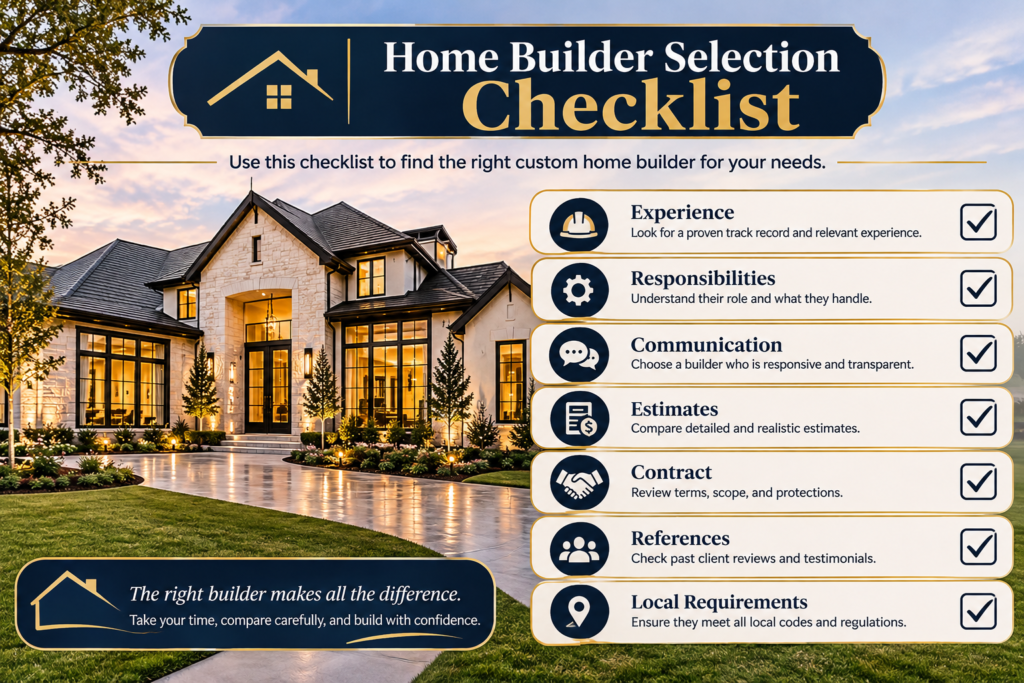
    Checklist of factors to consider when choosing a home builder in Texas.

    Before making your final decision, use this checklist to compare your options.

    What to checkQuestions to answer
    Relevant experienceHas the builder handled projects similar to yours?
    Project responsibilitiesDo you understand what the builder will and will not handle?
    ProcessCan the builder explain the major stages of the project?
    CommunicationDo you know who your main contact will be and how updates will work?
    EstimateIs the scope clear, with exclusions and allowances identified?
    Budget managementDo you understand how the builder will handle costs and changes?
    ContractDoes the written agreement reflect your discussions and agreed terms?
    ReferencesHave you spoken with previous clients or reviewed relevant completed work?
    Local requirementsHave you discussed the relevant property and jurisdiction-specific considerations?
    Overall fitDoes the builder understand your priorities and communicate clearly?

    When deciding how to choose a home builder in Texas, look at the complete picture. A suitable builder should explain their responsibilities, provide a clear basis for the proposed cost, discuss the project process, and put important agreements in writing.

    Do not rush the decision because one estimate looks attractive or a builder promises an especially quick start. Take the time to compare the details and make sure you understand what you are agreeing to.

    Frequently Asked Questions

    How do I know if a home builder is reliable?

    Look at relevant project experience, written estimates, references, communication, and the clarity of the proposed contract. Ask previous clients about their experience and pay attention to how the builder responds to your questions before you hire them.

    Should I choose the home builder with the lowest estimate?

    Not necessarily. A lower estimate may exclude materials, services, site work, or other costs that a competing proposal includes. Compare the scope, specifications, exclusions, allowances, and payment terms before deciding which estimate offers the better fit.

    What should be included in a home-building contract in Texas?

    The agreement should clearly explain the work the builder will perform, the cost or how the builder will determine it, the project schedule, and payment terms. It should also address specifications, responsibilities, and how both sides will handle changes. Texas Property Code Section 53.255 sets out a required residential construction contract disclosure statement and advises owners to obtain a written agreement.

    How many builders should I compare before making a decision?

    There is no fixed number that works for every project. Comparing multiple qualified builders can help you understand differences in scope, pricing, process, and responsibilities. Focus on the quality and completeness of the proposals rather than collecting estimates without comparing their details.

    Who is the best custom home builder in Houston?

    There is no single builder who is automatically the best choice for every homeowner. The right option depends on your project requirements, budget, design expectations, and preferred working relationship. Compare relevant experience, project responsibilities, written proposals, communication, and references before making a decision.

    When should I contact a home builder?

    You can contact builders once you have a general idea of your project, budget, and property situation. You do not need to have every design detail finalized, but clear priorities will make early discussions and proposals more useful.

    Ready to Discuss Your Home-Building Project?

    Choosing a builder is easier when you understand what your project needs and what to expect from the team responsible for carrying it out.

    Venus Builders provides residential construction services for new homes and custom-home projects in Texas. If you’re exploring your options, take a look at Venus Builders’ residential construction services to learn more about the work involved.

    Have a home-building project in mind? Schedule a consultation with Venus Builders to discuss your requirements, plans, and next steps.
  • How to Find Custom Home Builder Options for Your Project

    How to Find Custom Home Builder Options for Your Project

    Choosing a builder is one of the most important decisions you’ll make when planning a custom home. If you’re researching how to find custom home builder options, the challenge is not simply finding companies that offer residential construction. You need to identify a builder whose experience, working approach, communication, and proposal match the home you want to build.

    A builder may have an impressive portfolio but limited experience with your type of project. Another may offer a lower estimate but leave important costs or responsibilities unclear. Looking beyond the initial impression helps you make a more informed decision before committing to a major investment.

    For homeowners in Houston, the process should include reviewing relevant projects, speaking with previous clients, checking documentation, and understanding exactly what each builder is offering.

    How to Find Custom Home Builder Options for Your Project

    Start by creating a shortlist of builders who work on projects similar to yours. Referrals, professional recommendations, local research, and completed project portfolios can all help you identify potential candidates.

    However, finding names is only the first step. You need enough information to decide which builders are worth contacting.

    Start With Referrals and Recommendations

    Ask people who have recently built a custom home whether they would recommend their builder. Friends, family members, colleagues, and local professionals may be able to share useful experiences.

    A referral can help you discover builders you might not find through a basic online search. More importantly, it gives you an opportunity to ask about the actual working relationship.

    Try to find out:

    • Was the builder clear about the scope of work and costs?
    • Did they communicate regularly throughout the project?
    • How did they handle unexpected problems or changes?
    • Were decisions and responsibilities explained clearly?
    • Would the homeowner work with the same builder again?

    A recommendation is a useful starting point, but it should not replace your own research. Someone else’s project may have involved a different budget, design, location, or level of complexity.

    Research Builders Online

    Once you have a few names, review their websites and available project information.

    Look for details about:

    • The types of residential projects they undertake.
    • Their approach to custom home construction.
    • Examples of completed work.
    • The services they provide.
    • Their business information and contact details.

    Pay attention to whether the information is specific. A website that only says a company builds quality homes does not tell you much about the kind of work it can handle.

    Look for evidence that helps you understand the builder’s actual experience. If the website does not answer important questions, make a note to raise them during an initial conversation.

    If you’re still learning about the responsibilities involved in this type of project, read what a custom home builder actually does to understand the role before comparing potential providers.

    Build a Shortlist Before Scheduling Meetings

    You do not need to contact every builder you find. Narrow your options to a manageable group based on the information available.

    A useful initial shortlist should include builders who:

    • Work on the type of home you want to build.
    • Have relevant residential construction experience.
    • Can show examples of comparable projects.
    • Provide enough business information to evaluate their services.
    • Are willing to discuss your requirements and explain their process.

    The goal is to identify candidates worth investigating further, not to select someone based on a website or referral alone.

    Look for Experience That Matches Your Project

    A builder’s experience should be relevant to the home you want to create. The number of projects a company mentions is less useful than understanding what those projects involved.

    For example, a homeowner planning a custom home with a particular architectural style, complex layout, or specific material requirements should look for evidence that the builder has handled comparable work.

    Ask about experience with:

    • Similar home sizes and layouts.
    • Comparable architectural styles.
    • The materials and finishes you are considering.
    • Projects with similar site conditions.
    • The level of customization your plans require.

    You should also understand the builder’s role in the project. Will they manage construction activities directly? Who coordinates subcontractors? How are design decisions, material selections, and changes handled?

    These questions help reveal whether the builder’s experience aligns with the practical demands of your project.

    If you are still deciding what needs to be established before approaching builders, the custom home building guide, How to build a custom home: A step-by-step guide, provides broader context on the stages involved in building a home.

    Review the Builder’s Portfolio Carefully

    A portfolio helps you understand the kind of work a builder has completed. However, do not judge it only by attractive photographs.

    Look at the projects in more detail. Consider whether the homes reflect the design requirements, construction complexity, and finish quality you expect.

    When reviewing a portfolio, ask:

    • Are there examples of homes similar to the one I want?
    • Do the projects demonstrate different layouts and design requirements?
    • Are the materials and finishes relevant to my preferences?
    • Can the builder explain their involvement in each project?
    • Are there completed projects you can visit or discuss with previous clients?

    It is also useful to distinguish between a builder’s own completed work and images used for general inspiration. Ask whether the company was responsible for the construction of the homes shown and what its responsibilities included.

    A portfolio should give you something concrete to discuss. If you like a particular project, ask what decisions were involved, what challenges came up, and how the builder handled them.

    Check Credentials, Insurance, and Local Requirements

    Before moving further, understand what documentation is relevant to the builder and the work involved.

    This is particularly important in Houston because homeowners sometimes assume that every general contractor must hold a specific city or state general contractor license.

    That is not how the local system works. The City of Houston’s permitting information explains that the city does not license or register general contractors. Certain regulated trades, such as electrical and plumbing work, have separate licensing requirements.

    You can review the City of Houston’s permit submittal overview for information about permitting and contractor requirements.

    For regulated trade professionals, use the Texas Department of Licensing and Regulation license search to check applicable licenses. This is a trade-specific verification step, not a general contractor license search.

    You should also ask the builder for current insurance documentation and clarify what coverage applies to the project. Do not rely only on a verbal assurance. Request the relevant certificate and confirm its details with the issuing insurer when necessary.

    Depending on your project, useful questions include:

    • What insurance coverage does your company carry?
    • Can you provide current documentation?
    • Which subcontractors will perform regulated trade work?
    • How are the qualifications of those trade professionals verified?
    • Who is responsible for coordinating permits and inspections?

    For Houston-specific permitting information, the Houston Permitting Center and its online permit portal are useful official starting points.

    The aim is not to collect paperwork without understanding it. You want to know who is responsible for the work, what documentation is relevant, and how the project will meet applicable requirements.

    Speak With Previous Clients

    Speaking with previous clients can reveal details that a portfolio or company website cannot.

    A completed home may look impressive, but you also want to understand what it was like to work with the builder. Ask whether the client was kept informed, how problems were handled, and whether the final work matched the agreed scope.

    If the builder can provide references, consider asking:

    • Was the original project scope explained clearly?
    • Were costs and potential changes communicated properly?
    • Did the builder respond to questions in a reasonable timeframe?
    • How were unexpected issues handled?
    • Were subcontractors and other project participants coordinated effectively?
    • Were there disagreements, and how were they resolved?
    • Would you hire this builder again?

    Where possible, speak with clients whose projects are similar to yours. Their experience may be more relevant than feedback from a homeowner who completed a very different type of build.

    You can also ask whether they would be comfortable discussing the project in more detail or showing you the completed home.

    A reference should help you understand the builder’s working practices, not simply confirm that someone was satisfied.

    Meet the Builders and Evaluate Communication

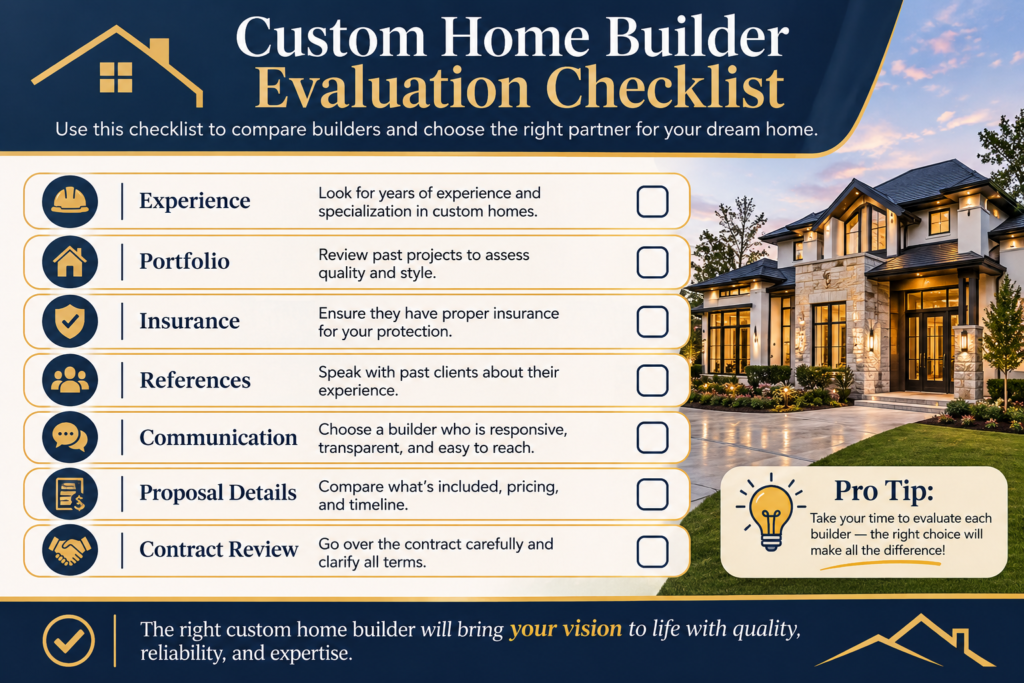
    Checklist of factors to evaluate when choosing a custom home builder in Houston

    After reviewing portfolios, documentation, and references, arrange conversations with the builders who remain on your shortlist.

    Use these meetings to explain what you want to build and understand how each company approaches the project.

    You do not need a fully finalized design to start the conversation. However, having an initial idea of your requirements will make the discussion more useful.

    Be prepared to explain:

    • The type and approximate size of home you are considering.
    • Your preferred location or property situation.
    • The design features that matter most to you.
    • Your initial budget expectations.
    • Any particular materials, finishes, or functional requirements.
    • Your expected decision-making process.

    Then ask the builder how they would approach the next stages.

    Pay attention to how they respond. Do they ask relevant questions? Do they explain what information they still need? Are they clear about what is included in their services and what may require additional professionals?

    Communication matters throughout a custom home project because decisions, approvals, materials, costs, and construction activities need to be coordinated.

    Before choosing a builder, understand:

    • Who will be your main point of contact?
    • How often will project updates be provided?
    • How will design changes be discussed and approved?
    • How will questions and unexpected issues be handled?
    • Who will explain changes to the budget or schedule?

    A good initial meeting should leave you with a clearer understanding of the builder’s approach, not just a positive sales impression.

    Compare Proposals Before Making a Decision

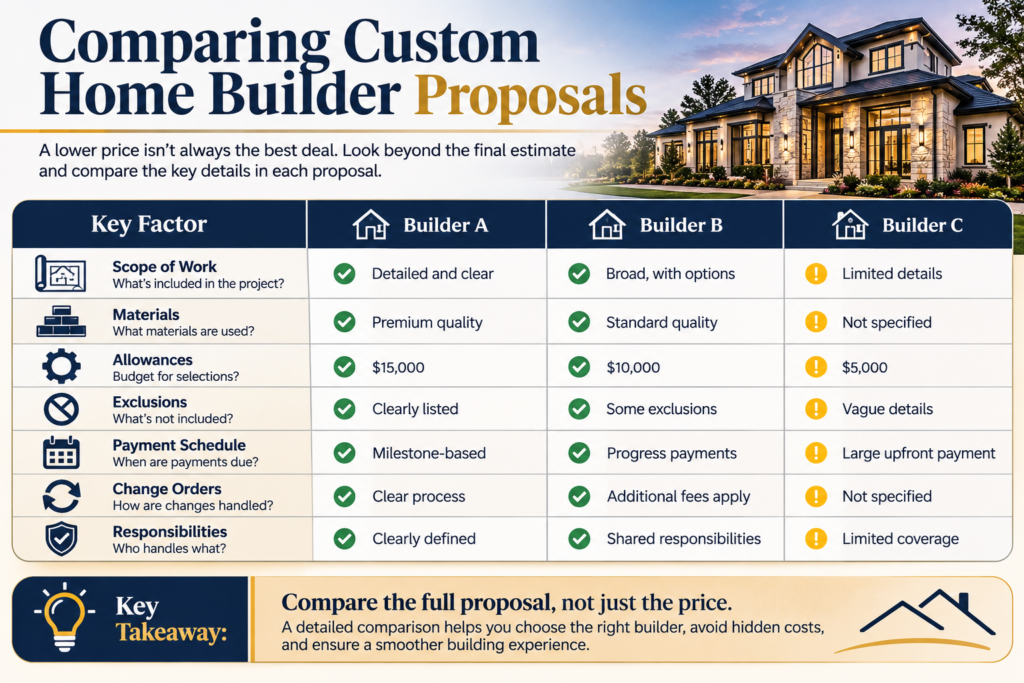
    Comparison of custom home builder proposals showing scope, materials, allowances, exclusions, and payment terms.

    Once you have discussed your project with potential builders, review their proposals carefully. Do not compare them only by the final price.

    Two proposals can look very different because they may include different scopes of work, materials, allowances, exclusions, and responsibilities.

    Before comparing estimates, check whether each proposal explains:

    ItemWhat to review
    Scope of workWhich construction activities and services are included?
    Materials and finishesAre specifications clear, or are they still subject to selection?
    AllowancesWhat amounts have been allocated for items that have not been finalized?
    ExclusionsWhich costs, services, or activities are not included?
    Payment scheduleWhen are payments due, and what work or milestones are they tied to?
    Change ordersHow will changes be priced, approved, and documented?
    Project responsibilitiesWho coordinates subcontractors, permits, inspections, and other activities?
    ScheduleWhat assumptions and dependencies affect the proposed timeline?

    Look Beyond the Lowest Estimate

    A lower proposal is not necessarily the better option.

    For example, one builder may include certain materials and services in the estimate, while another may leave them as allowances or exclude them entirely. The second proposal can appear cheaper even though the final project cost may be different once those items are added.

    Ask each builder to explain unclear figures, assumptions, and exclusions. If something is not included, find out whether it will be handled separately and how the cost will be determined.

    Understand the Contract Before Signing

    Once you have selected a preferred builder, review the proposed agreement carefully.

    Make sure you understand the project scope, payment terms, responsibilities, change-order process, schedule provisions, and procedures for handling disagreements.

    Do not assume that a verbal discussion automatically forms part of the written agreement. Important decisions and commitments should be documented.

    If the agreement involves substantial financial or legal obligations, consider having a qualified construction attorney review it before signing.

    The goal is to know exactly what you are agreeing to, what the builder is responsible for, and how changes will be handled once the project begins.

    Watch for These Warning Signs

    Some issues become easier to identify when you know what to look for. Be cautious if a builder:

    • Cannot provide relevant examples of completed work.
    • Avoids reasonable questions about project responsibilities.
    • Is unwilling to provide references or explain previous projects.
    • Gives an estimate with vague scope descriptions and unclear exclusions.
    • Cannot explain how changes to the project will be priced and approved.
    • Makes promises about cost or timing without understanding the project requirements.
    • Provides incomplete or unclear insurance documentation.
    • Pressures you to sign before you have reviewed the proposal and agreement.
    • Relies on verbal assurances for important project details.

    One concern does not automatically prove that a builder is unsuitable. However, repeated gaps in documentation, communication, or transparency deserve attention.

    You should be comfortable asking questions and receiving clear explanations before making a commitment.

    Final Checklist: Choosing the Right Custom Home Builder

    Before making your decision, review the following points:

    • The builder has experience relevant to my project.
    • I have reviewed examples of comparable completed work.
    • I understand the builder’s role and project responsibilities.
    • I have checked relevant business and insurance documentation.
    • I understand who will handle regulated trade work.
    • I have spoken with previous clients or checked available references.
    • The builder has explained how communication and project updates will work.
    • I have reviewed the scope, allowances, exclusions, and payment schedule.
    • I understand how changes and additional costs will be handled.
    • I have reviewed the written agreement before signing.

    If you’re still considering how to find custom home builder options, remember that the best decision comes from comparing the full working relationship, not just the portfolio or initial estimate.

    The right choice should make sense for your project’s requirements, the builder’s relevant experience, the proposed scope, and the way both sides will work together.

    Explore Custom Home Construction With Venus Builders

    Finding a builder is easier when you know what to evaluate. Start with a clear understanding of your project, ask specific questions, and compare potential providers based on their experience, documentation, communication, and proposals.

    Venus Builders provides residential construction services for homeowners exploring custom home projects in Texas.

    If you are planning a custom home in Houston, explore Venus Builders’ residential construction services (https://venus-builders.com/services/residential-construction) to learn more about the available services and discuss your project requirements.

    Frequently Asked Questions

    How do I find a reliable custom home builder?

    Start with referrals, local research, and examples of completed projects. Then evaluate relevant experience, insurance documentation, references, communication, and written proposals. Do not make a decision based only on a website or the lowest estimate.

    How many custom home builders should I compare?

    There is no fixed number. Start with a manageable shortlist of builders whose experience appears relevant to your project. Compare the strongest candidates in enough detail to understand their proposals, responsibilities, and working approaches.

    What should I ask a custom home builder before hiring them?

    Ask about comparable projects, project responsibilities, insurance, subcontractors, communication, payment schedules, allowances, exclusions, and change orders. You should also ask for references and clarification of anything that is not clear in the proposal.

    Do general contractors need a license in Houston, Texas?

    The City of Houston does not license or register general contractors. However, certain trades, including electrical and plumbing work, have separate licensing requirements. Homeowners should verify applicable trade qualifications and understand who is responsible for the work on their project.

    Should I choose the custom home builder with the lowest estimate?

    Not automatically. Compare the scope of work, material specifications, allowances, exclusions, payment terms, and responsibilities. A lower estimate may leave out items that another proposal includes, so make sure you are comparing equivalent work before deciding.

    When should I sign a custom home construction contract?

    Sign only after you understand the written scope, payment terms, responsibilities, schedule provisions, and change-order process. Make sure important discussions are reflected in the agreement, and consider professional legal review before committing to substantial obligations.

  • How to Build a Custom Home: A Step by Step Guide

    How to Build a Custom Home: A Step by Step Guide

    Building a custom home gives you the opportunity to create a space around your needs, lifestyle, and long term plans. But before construction begins, you need a clear plan for the property, budget, design, approvals, and construction process.

    If you are researching how to build a custom home, start by understanding the planning decisions that shape the project. Our guide to How to Start a Construction Project: Step-by-Step Guide explains the broader process of getting a construction project underway, while this article focuses specifically on the steps involved in building a custom home.

    The right construction team can also help you evaluate your plans, understand the scope of work, and coordinate the steps involved in bringing your home to life. Explore Venus Builders’ Residential Construction services to learn more about its residential construction offering in Texas.

    This guide explains the steps involved in building a custom home, from defining your goals and choosing land to construction, final inspections, and handover.

    How to Build a Custom Home: The Main Steps

    Although every project is different, the custom home building process generally follows these stages:

    1. Define your needs and priorities.
    2. Choose a suitable property.
    3. Establish a realistic budget.
    4. Plan the home’s design and layout.
    5. Assess the property and prepare the site.
    6. Finalize plans, approvals, and construction arrangements.
    7. Begin construction.
    8. Monitor progress and manage changes.
    9. Complete final checks and prepare for handover.

    Working through these stages in order helps you identify important decisions early and reduce avoidable changes once construction is underway.

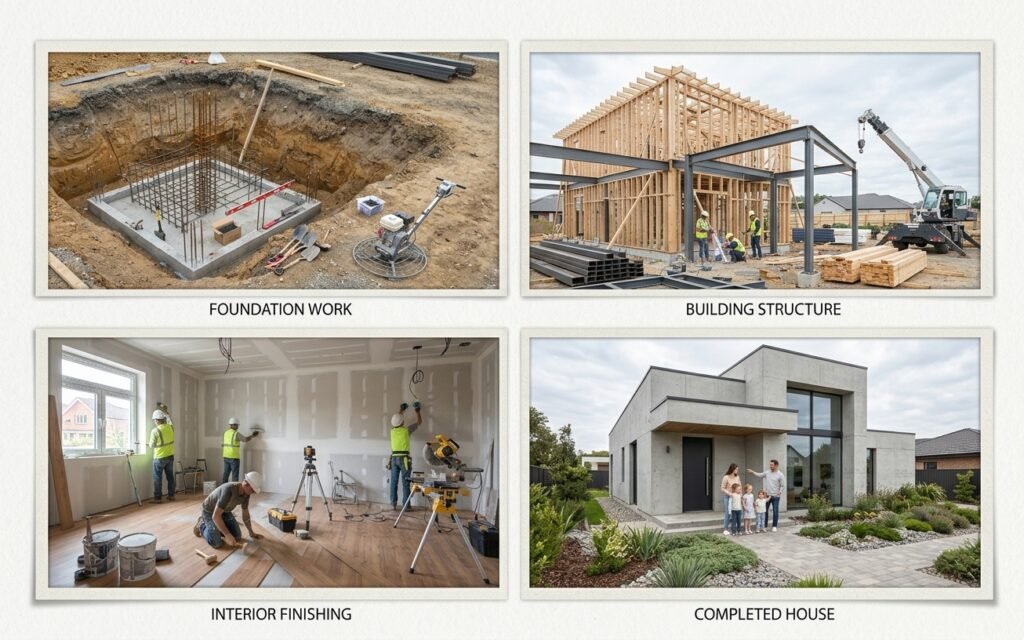
    Steps in the custom home building process from planning to final handover.

    Step 1: Define Your Needs and Priorities

    Before discussing floor plans or materials, decide what you want your home to achieve.

    Think about how many people will live in the house, how much space you need, and how you expect your needs to change over time. A growing family, for example, may prioritize additional bedrooms and flexible living areas, while someone planning to work from home may need a dedicated office.

    Consider questions such as:

    • How many bedrooms and bathrooms will you need?
    • Do you prefer an open-plan layout or separate living spaces?
    • Will you need a home office, guest room, or outdoor living area?
    • What accessibility or future family needs should the design accommodate?
    • Which features are essential, and which would be nice to have?

    Create a list of priorities before moving into design discussions. This gives your builder and design team a clearer understanding of your expectations and helps guide decisions about space, materials, and cost.

    Step 2: Choose the Right Property

    The property you choose will influence the design, preparation work, budget, and overall construction process.

    If you already own land, have it assessed before finalizing your home design. If you are still looking for a property, consider more than its purchase price or location.

    Important factors include:

    • Site conditions: The slope, soil, drainage, and other physical characteristics may affect site preparation and foundation requirements.
    • Access and utilities: Confirm whether the property has suitable access and the required utility connections.
    • Local requirements: Zoning, building restrictions, setbacks, and other applicable requirements may limit where or how you can build.
    • Drainage and flood exposure: Understand how water moves across the property and whether additional drainage measures may be needed.
    • Design suitability: Consider whether the property can accommodate your preferred home size, layout, and outdoor spaces.

    If you are building in a Texas coastal area, windstorm requirements may also affect your construction planning. Depending on the property’s location and applicable requirements, you may need to consider windstorm inspections and related documentation. The Texas Department of Insurance’s Windstorm Inspection Program provides information about the program and its requirements.

    A property assessment can help identify constraints before they become expensive design or construction problems.

    Step 3: Establish a Realistic Budget

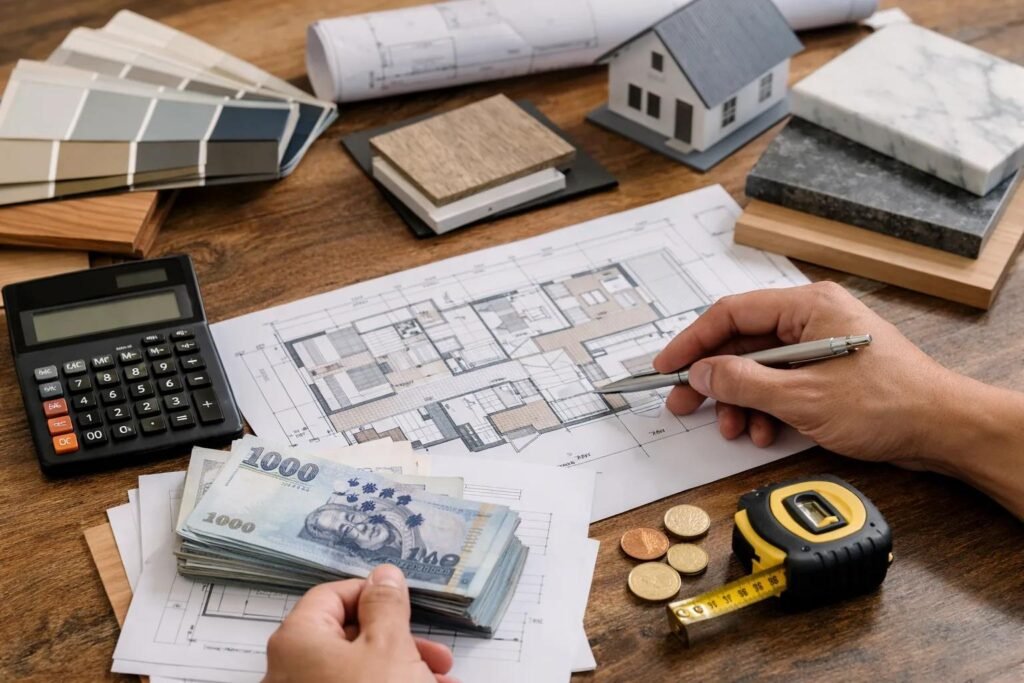
    Main cost categories to consider when budgeting for a custom home.

    Your budget should account for the full scope of the project, not just the construction work itself.

    When planning how to build a custom home, it is important to understand the potential costs before committing to a design. The final amount will depend on factors such as the property, home size, materials, finishes, site conditions, and project requirements.

    Your budget may need to include:

    • Land purchase, if you do not already own the property
    • Architectural and design services
    • Engineering and other professional services
    • Site preparation and foundation work
    • Construction labor and materials
    • Plumbing, electrical, HVAC, and other building systems
    • Interior finishes, fixtures, and appliances
    • Permits, inspections, and applicable fees
    • Landscaping, driveways, and other exterior work
    • A contingency allowance for unexpected costs

    Ask your builder to clarify what is included in the proposed budget and what may be priced separately. This helps you compare estimates more accurately and understand where additional expenses could arise.

    If your priorities exceed your available budget, decide which features matter most before finalizing the design. Making these decisions early is generally easier than changing the plan after construction has started.

    Step 4: Plan the Home’s Design and Layout

    Once you understand your needs, property constraints, and budget, you can begin developing the home’s design.

    The design should balance appearance with everyday function. Room sizes, circulation, storage, natural light, privacy, and connections between indoor and outdoor spaces can all affect how comfortable the finished home will be.

    During this stage, work through decisions such as:

    • Overall floor plan and room arrangement
    • Number and size of bedrooms and bathrooms
    • Kitchen layout and storage requirements
    • Window placement and natural lighting
    • Exterior appearance and architectural style
    • Materials, finishes, and fixtures
    • Energy efficiency and building-system requirements
    • Future flexibility, maintenance, and accessibility

    Review the plans carefully before approving them. Changes to room layouts, structural elements, or building systems may become more complicated once construction is underway.

    Your builder and design professionals can help you evaluate how your preferences fit the property’s conditions, applicable requirements, and project budget.

    Step 5: Assess the Property and Prepare the Site

    Before construction begins, the project team needs to understand the site and determine what preparation work is required.

    Depending on the property and project scope, this stage may involve surveys, soil evaluations, drainage planning, utility coordination, clearing, grading, or other site work.

    These activities help establish the conditions for the foundation and subsequent construction. The exact requirements will vary based on the property, local regulations, and the approved design.

    Do not assume every property will require the same preparation. A site with challenging slopes, drainage issues, or unsuitable soil conditions may require additional planning and work.

    Identifying these conditions early helps the project team make more informed decisions about construction methods, scheduling, and costs.

    Step 6: Finalize Plans, Approvals, and Construction Arrangements

    Before physical construction starts, make sure the plans, responsibilities, and project arrangements are sufficiently clear.

    Depending on the project and its location, required steps may include obtaining applicable permits and approvals, coordinating engineering documents, confirming material selections, and finalizing the construction agreement.

    Review the agreement carefully so you understand:

    • The work included in the project
    • The responsibilities of the builder and owner
    • The proposed payment schedule
    • The expected project timeline
    • How changes to the scope or materials will be handled
    • How allowances, exclusions, and additional costs are documented
    • How communication and progress updates will work

    Approval requirements vary by jurisdiction and project. Confirm the applicable requirements with the relevant local authority and your project professionals before work begins.

    If you are still deciding how to organize the early stages of your project, read our guide to How to Start a Construction Project: Step-by-Step Guide for a broader overview of planning, preparation, and getting a construction project underway.

    Step 7: Begin Construction

    Once the required preparations and approvals are in place, construction can move forward according to the project’s plans and schedule.

    The sequence depends on the design and construction method, but a typical custom home project may include:

    1. Site preparation and foundation work
    2. Structural framing
    3. Roofing, windows, and exterior enclosure
    4. Plumbing, electrical, and HVAC installation
    5. Insulation and interior wall work
    6. Interior finishes, cabinetry, fixtures, and flooring
    7. Exterior work and remaining site improvements

    These stages are connected. For example, certain building systems must be installed and inspected before walls can be closed, while finish selections may affect when specific materials can be ordered or installed.

    Your builder should explain the planned sequence and communicate when key decisions, inspections, or selections are needed from you.

    Step 8: Monitor Progress and Manage Changes

    Building a custom home involves many decisions, and some details may need to be adjusted as the project progresses. The key is to manage changes through a clear process.

    Maintain regular communication with your builder and ask for updates on progress, upcoming decisions, budget changes, and potential schedule issues.

    If you want to change a layout, material, fixture, or other part of the design, discuss the implications before approving the change. Depending on the work involved, it could affect the price, construction sequence, material availability, or completion date.

    A written change process helps everyone understand what is changing and what the change means for the project.

    It is also useful to keep project documents, approved selections, progress updates, and decisions organized in one place. This makes it easier to refer back to agreed details when questions arise.

    Step 9: Complete Final Checks and Prepare for Handover

    As construction approaches completion, the project team should identify remaining work and confirm that applicable inspections and required closeout steps are addressed.

    Before accepting the completed home, review the property carefully with your builder. Depending on the project, this may include checking:

    • Doors, windows, and hardware
    • Cabinets, countertops, flooring, and finishes
    • Plumbing fixtures and water flow
    • Electrical fixtures and outlets
    • Heating, ventilation, and air conditioning systems
    • Paintwork and other visible finishes
    • Exterior areas and agreed site improvements
    • Outstanding items that need correction

    Document any incomplete work or issues and agree on how they will be addressed. Ask for relevant warranties, product information, operating instructions, and other handover documents.

    The goal is to understand the condition of the completed home, know how its systems operate, and have a clear record of any remaining items.

    How Long Does It Take to Build a Custom Home?

    The timeline depends on the home’s size and complexity, design requirements, property conditions, approvals, material availability, and construction schedule.

    Planning and design can take a substantial amount of time before construction begins. Once work starts, the schedule may also be affected by weather, inspections, supply delays, design changes, or unexpected site conditions.

    Rather than relying on a single general estimate, ask your builder for a project-specific schedule that identifies the main stages, expected milestones, and decisions needed from you.

    For a closer look at scheduling, see our related guide on the custom home building timeline.

    Common Mistakes to Avoid When Building a Custom Home

    Understanding how to build a custom home also means knowing which avoidable mistakes can create problems later.

    Starting without a clear budget. If you have not accounted for professional services, site work, finishes, and other project costs, your initial budget may not reflect the full scope of the build.

    Choosing land before understanding its limitations. Soil, drainage, access, and local restrictions can affect what is practical to build on a property.

    Finalizing the design without reviewing the details. Unresolved layout choices or material selections may lead to changes during construction.

    Comparing builders on price alone. Review the proposed scope, exclusions, communication process, experience relevant to your project, and contract terms alongside the price.

    Making undocumented changes. Verbal decisions can lead to misunderstandings about cost, scope, or timing. Keep approved changes in writing.

    Underestimating the importance of communication. Regular updates and clear responsibilities help everyone respond to issues before they become larger problems.

    Taking time to address these areas before and during construction can help you make more confident decisions throughout the project.

    How to Choose the Right Custom Home Builder

    Your builder plays an important role in coordinating the work required to turn your plans into a completed home. Look for a professional who understands your project requirements, communicates clearly, and can explain the construction process and associated costs.

    Before making a decision, consider:

    • Experience with projects similar to yours
    • Clarity of the proposed scope and budget
    • Communication and progress-reporting practices
    • Approach to scheduling and managing changes
    • Relevant references and examples of previous work
    • Contract terms, responsibilities, and documentation

    Ask questions whenever something in the proposal or process is unclear. A useful discussion before signing can help establish expectations and make it easier to work together once construction begins.

    Venus Builders offers residential construction services for projects in Texas. You can explore the Residential Construction service page to learn more about its residential construction offering.

    Frequently Asked Questions

    What is the first step in building a custom home?

    Start by defining your needs, priorities, and budget. These decisions help guide your property search, design, and discussions with potential builders.

    Can I build a custom home on land I already own?

    Yes, provided the property can accommodate your proposed project and the applicable requirements can be met. Review the land’s conditions, access, utilities, and local restrictions before finalizing the design.

    Should I choose a builder before finalizing my home design?

    It can be helpful to involve a suitable builder early enough to discuss feasibility, budget, scheduling, and construction requirements. The right timing depends on your project and the professionals involved.

    What should a custom home budget include?

    It should account for the construction scope and other relevant expenses, such as design and engineering services, site preparation, permits and inspections, materials, finishes, exterior work, and a contingency allowance. Confirm which items are included in each estimate.

    Can I change the design after construction begins?

    Changes may be possible, but their effect depends on the work involved and the stage of construction. Ask for the cost and schedule implications in writing before approving a change.

    Do I need permits to build a custom home in Texas?

    Permit and approval requirements depend on the property’s location and the nature of the project. Check with the relevant local authority and your project professionals to determine which requirements apply.

    How do I choose a custom home builder?

    Compare relevant experience, scope and pricing clarity, communication practices, references, contract terms, and how the builder manages scheduling and changes. Choose based on the overall fit for your project rather than price alone.

    Ready to Plan Your Custom Home?

    Building a custom home involves many connected decisions, from choosing the right property and setting a realistic budget to coordinating construction and preparing for handover.

    A clear process helps you understand those decisions before they become problems. If you are planning a residential construction project in Texas, explore Venus Builders’ Residential Construction services to learn more about the company’s residential construction offering.

    You can also begin with our guide to How to Start a Construction Project: Step-by-Step Guide to review the broader planning process.

  • How to Start a Construction Project: Step-by-Step Guide

    How to Start a Construction Project: Step-by-Step Guide

    Starting a construction project can feel like a lot at once. You may know what you want to build, remodel, or change, but not know what should happen first.

    The best place to start is by defining the project, understanding what type of construction work you need, checking the property and site, setting a realistic budget, planning the design, and then choosing the right professionals to take the project forward.

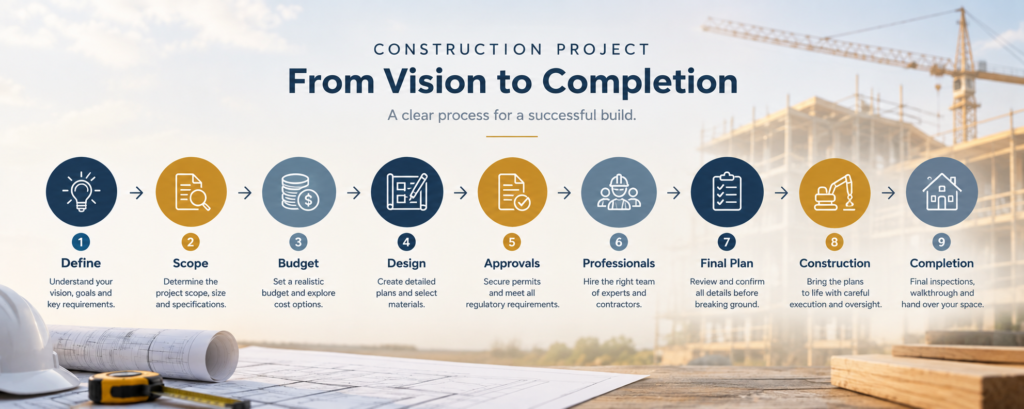
    This guide walks through the main construction project steps, from the first idea through planning, construction, and completion.

     Construction project steps from planning through completion

    What should you do first when starting a construction project?

    Start by clearly defining what you want to build or change and why.

    Before contacting a contractor or discussing construction costs, you should have a basic understanding of:

    • What you want to build, remodel, or renovate
    • Where the project will take place
    • Whether it is residential or commercial construction
    • What you want the finished space to achieve
    • Any major requirements or features you already have in mind
    • Your general budget expectations
    • When you would ideally like the project completed

    You do not need every detail figured out at this stage. The goal is to turn a general idea into a project that can be properly planned.

    From there, you can work through the main stages of construction project planning.

    Step 1: Decide what you want to build or change

    The first question is simple: what exactly are you trying to accomplish?

    You might be:

    • Building a new custom home
    • Building on land you already own
    • Constructing a commercial property
    • Completing a commercial build-out
    • Remodeling an existing home
    • Renovating a commercial space
    • Redesigning an interior
    • Changing the layout or use of an existing space

    The more clearly you can describe the project, the easier it becomes to determine what professionals, designs, approvals, budget, and timeline you may need.

    For example, someone planning a new custom home will have a very different process from someone renovating a kitchen or completing a commercial tenant improvement.

    If you are considering a new custom home, our guide on how to build a custom home goes deeper into that process.

    Step 2: Identify the type of construction project

    Once you know what you want to accomplish, identify the type of project you are actually planning.

    New residential construction

    This includes projects such as custom homes and other new residential structures.

    If you are building a new home, the process can involve land evaluation, architectural design, engineering, budgeting, permitting, construction, and final completion.

    See our guide to how to build a house in Texas for a closer look at the residential construction process in Texas.

    Commercial construction

    Commercial construction can include new commercial buildings, tenant improvements, build-outs, and other commercial projects.

    The requirements can vary significantly depending on the property, intended use, site, design, and local requirements.

    Our guide to commercial construction in Houston explains what the commercial construction process can look like from planning through completion.

    Remodeling and renovation

    If you already own or occupy a property, you may not need new construction. Remodeling or renovation may be the better fit.

    This could involve:

    • Kitchen remodeling
    • Bathroom remodeling
    • Whole-home renovation
    • Commercial renovation
    • Layout changes
    • Interior upgrades

    If you are planning a residential project, see our guide on home remodeling in Houston to understand where the process begins.

    Interior design

    Some projects need more than construction alone. Interior planning can affect how a space functions, looks, and connects to the construction work.

    For example, space planning, materials, lighting, furniture, finishes, and layout decisions may need to be addressed before construction begins.

    Our guide on what an interior designer does during a construction project explains where interior design fits into the wider process.

    Step 3: Understand the property and site

    Before detailed planning begins, you need to understand the property where the project will happen.

    For a new construction project, this can include looking at:

    • The property’s location
    • Site conditions
    • Existing structures
    • Access to the site
    • Utilities
    • Zoning considerations
    • Property restrictions
    • Existing plans or surveys
    • Local permitting requirements

    For an existing property, you also need to understand the current condition of the structure and how much of it can realistically be changed.

    This step matters because the property itself can affect the scope, design, construction budget, and timeline.

    Step 4: Define the project scope

    Your project scope explains what the construction project actually includes.

    It should become increasingly specific as planning progresses.

    Depending on the project, the scope may cover:

    • Structural work
    • Floor plans and layout changes
    • Interior design
    • Materials and finishes
    • Electrical work
    • Plumbing
    • HVAC
    • Exterior work
    • Demolition
    • Remodeling
    • Site work
    • Fixtures and equipment

    A clear scope helps everyone understand what is included and what is not.

    This becomes particularly important when discussing estimates and comparing contractors. Two contractors can give different prices because they are not necessarily pricing the exact same scope of work.

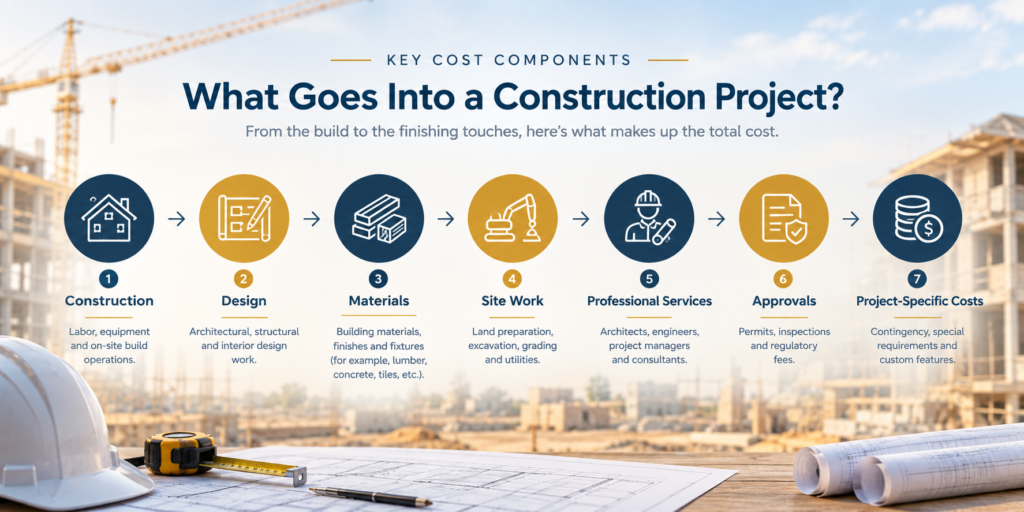
    Step 5: Develop a realistic construction budget

     Main categories to consider when planning a construction budget

    Once the scope becomes clearer, you can start developing a realistic construction budget.

    Your budget should account for more than the basic cost of construction. Depending on the project, you may also need to consider:

    • Design and architectural work
    • Engineering
    • Permits and approvals
    • Materials
    • Labor
    • Site work
    • Interior finishes
    • Equipment or fixtures
    • Project management
    • Changes that may arise during construction

    The exact budget will depend on the type, size, location, design, materials, and scope of the project.

    For residential projects, our guide on custom home construction cost explains some of the factors that can affect the budget.

    For commercial projects, see commercial construction cost to understand what can influence a commercial construction budget.

    Step 6: Plan the design before construction

    Design should happen before major construction work begins.

    Depending on the project, this can involve:

    • Architectural plans
    • Floor plans
    • Structural plans
    • Interior layouts
    • Material selections
    • Lighting plans
    • 3D visualizations
    • Engineering
    • Construction drawings

    Good planning gives you an opportunity to make important decisions before they become expensive changes during construction.

    Space planning is also important because the layout of a building can affect how people use it every day. You can learn more in our guide on how space planning can change the way your home works.

    For projects where visualising the finished space is difficult, 3D interior design before construction can help you understand the proposed space before work begins.

    Step 7: Understand permits and approvals

    Construction projects may require permits, inspections, approvals, or other documentation before certain work can begin.

    The requirements depend on factors such as:

    • Project type
    • Property location
    • Scope of work
    • Building use
    • Structural changes
    • Local regulations

    For projects in Houston, the official City of Houston permitting resources can help property owners understand local permitting requirements.

    It is important to identify these requirements early rather than discovering them after construction planning is already underway.

    Step 8: Choose the right professionals

    Once you understand the project, scope, budget, and design requirements, you can determine which professionals you need.

    Depending on the project, this could include:

    • Architect
    • Interior designer
    • Structural engineer
    • Civil engineer
    • General contractor
    • Construction project manager
    • Specialist subcontractors

    The exact team depends on the project.

    For example, a custom home may require a different combination of professionals than a commercial build-out or a home renovation.

    You should also understand what each professional is responsible for before hiring them. Our guide on what a custom home builder actually does explains the role of a builder in a residential construction project.

    If you are comparing residential builders, see questions to ask a custom home builder before hiring one.

    For commercial projects, our guide on how to choose a commercial contractor covers the questions worth considering before making a decision.

    Step 9: Confirm the scope, budget, and construction timeline

    Before construction starts, the major project details should be clearly understood.

    At this stage, you should have a clearer picture of:

    • What is being built or changed
    • What is included in the scope
    • What the budget covers
    • What the design includes
    • Who is responsible for what
    • What approvals are required
    • What the expected construction timeline looks like
    • How changes will be handled

    The more clearly these details are established before construction begins, the easier it is to manage expectations during the project.

    For custom homes, our guide on custom home building timelines explains the factors that can affect how long construction takes.

    For commercial projects, see how long a commercial build-out takes.

    Step 10: Move from planning into construction and project management

    Once the plans, scope, budget, and schedule are ready, the project moves into construction.

    This is where construction project management becomes especially important.

    Project management can involve:

    • Coordinating contractors and vendors
    • Managing the construction schedule
    • Monitoring project costs
    • Coordinating different phases of work
    • Tracking progress
    • Addressing issues
    • Managing changes
    • Maintaining communication
    • Monitoring quality and safety

    A construction project does not simply move from plans to completion on its own. The different parts of the project need to stay coordinated throughout construction.

    If you want to understand this part of the process in more detail, see construction project management: what it actually covers.

    Step 11: Complete the project and prepare for handover

    The final stage is more than simply finishing construction.

    Before the project is considered complete, the team may need to address:

    • Final inspections
    • Outstanding work
    • Corrections or adjustments
    • Final installations
    • Quality checks
    • Documentation
    • Client walkthroughs
    • Handover requirements

    The exact completion process depends on the type of project and the agreement between the parties.

    A clear handover helps make sure the finished project matches the agreed scope as closely as possible.

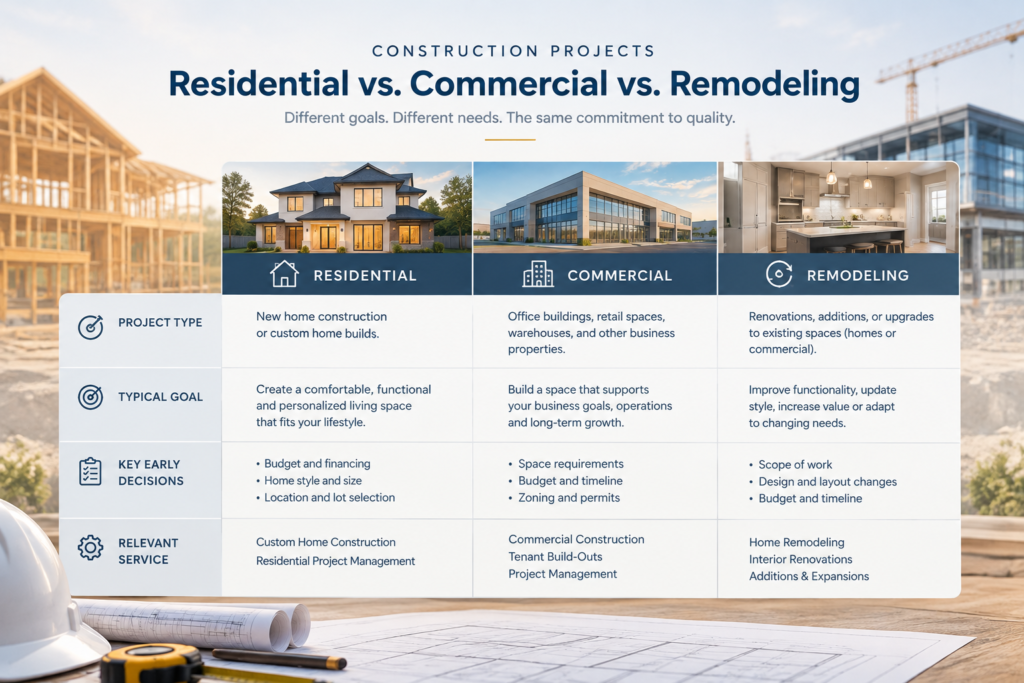
    How do you know which construction service you need?

    Comparison of residential commercial and remodeling construction projects

    If you are not sure what type of construction service fits your project, start with the outcome you want.

    If you want to…You may need…
    Build a new homeResidential construction / custom home construction
    Build on land you already ownBuild-on-your-lot construction
    Construct a commercial propertyCommercial construction
    Change an existing commercial spaceCommercial renovation or build-out
    Renovate your homeResidential remodeling or renovation
    Redesign how a space functionsInterior design / space planning
    Manage a complex construction projectConstruction project management

    The right service depends on your property’s condition, project scope, goals, and construction requirements.

    What should you prepare before contacting a builder or contractor?

    You do not need a complete set of architectural plans before your first conversation.

    However, it helps to have some basic information ready:

    ✔ Property address or general location

    ✔ Type of project

    ✔ What you want to build or change

    ✔ Approximate size of the project

    ✔ Any plans, drawings, or property documents you already have

    ✔ Desired features or finishes

    ✔ General budget range

    ✔ Preferred timeline

    ✔ Any major concerns or constraints

    The more information you can provide, the easier it is for the construction professional to understand what you are trying to accomplish.

    What commonly causes construction projects to go off track?

    Construction projects can become difficult when important decisions are unclear or change repeatedly after work has started.

    Common issues include:

    • An unclear project scope
    • An unrealistic construction budget
    • Design changes during construction
    • Poor communication
    • Delayed decisions
    • Unclear responsibilities
    • Coordination problems
    • Incomplete planning
    • Unexpected site conditions
    • Delays in materials or approvals

    Budget and timeline problems are often connected. A change to the design can affect materials, labor, scheduling, and other parts of the project.

    Our guide on why construction projects go over budget explains some of the common causes, while how to avoid construction delays focuses on the factors that can affect the schedule.

    Simple construction project planning checklist

    Before moving into construction, make sure you have considered:

    • Defined the project goal
    • Identified the type of construction project
    • Reviewed the property and site
    • Defined the project scope
    • Established a realistic budget
    • Planned the design
    • Identified permit and approval requirements
    • Determined which professionals are needed
    • Compared potential contractors or construction professionals
    • Reviewed the proposed scope and budget
    • Established an expected timeline
    • Discussed how changes will be handled
    • Confirmed how communication and project management will work

    You do not have to solve every item alone. The purpose of this checklist is to help you understand what needs to be considered before construction begins.

     Construction project planning checklist before construction begins

    Frequently Asked Questions

    How do I start a construction project?

    Start by defining what you want to build or change. Then identify the project type, review the property and site, establish the scope and budget, plan the design, understand approval requirements, and choose the professionals needed to move the project forward.

    What are the main stages of a construction project?

    The main stages typically include defining the project, site and feasibility considerations, scope and budgeting, design, approvals, professional selection, pre-construction planning, construction, project management, and completion.

    When should I hire a contractor?

    A contractor should generally be involved early enough to help you understand construction requirements, scope, costs, scheduling, and how the project can be executed. The exact timing depends on the type and complexity of the project.

    Do I need an architect for a construction project?

    It depends on the project. New construction, major structural changes, and projects requiring detailed architectural plans may require architectural services, while smaller projects may have different requirements.

    How do I create a construction budget?

    Start with the project scope and then account for construction work, design, engineering, permits, materials, labor, site work, finishes, and other project-specific costs. A construction professional can help develop a more detailed budget as the project becomes defined.

    How long does a construction project take?

    There is no single timeline for every construction project. The duration depends on the type, size, scope, design, approvals, site conditions, materials, and complexity of the work.

    What should I ask a contractor before hiring them?

    Ask about their experience with similar projects, proposed scope, timeline, budget, responsibilities, communication process, project management, and how changes will be handled.

    Ready to Start Your Construction Project?

    You do not need to have every decision made before starting the conversation.

    The first step is understanding what you want to accomplish, what type of project you have, and what needs to happen before construction can begin.

    Venus Builders works across residential construction, commercial construction, interior design, remodeling and renovation, and construction project management. If you are planning a project in Houston or elsewhere in Texas, you can contact Venus Builders to discuss your project and determine what the next steps should look like.